Reimagining Curriculum Adoption: Notes from the Education Agency Practice’s Fall 2026 Convening
Most district leaders know how to pick a curriculum. Fewer have a reliable way to answer the questions that come after: Will teachers be ready to use it? Can we afford it in year three, not just year one? What happens when math, ELA, and science adoptions all land in the same school year?
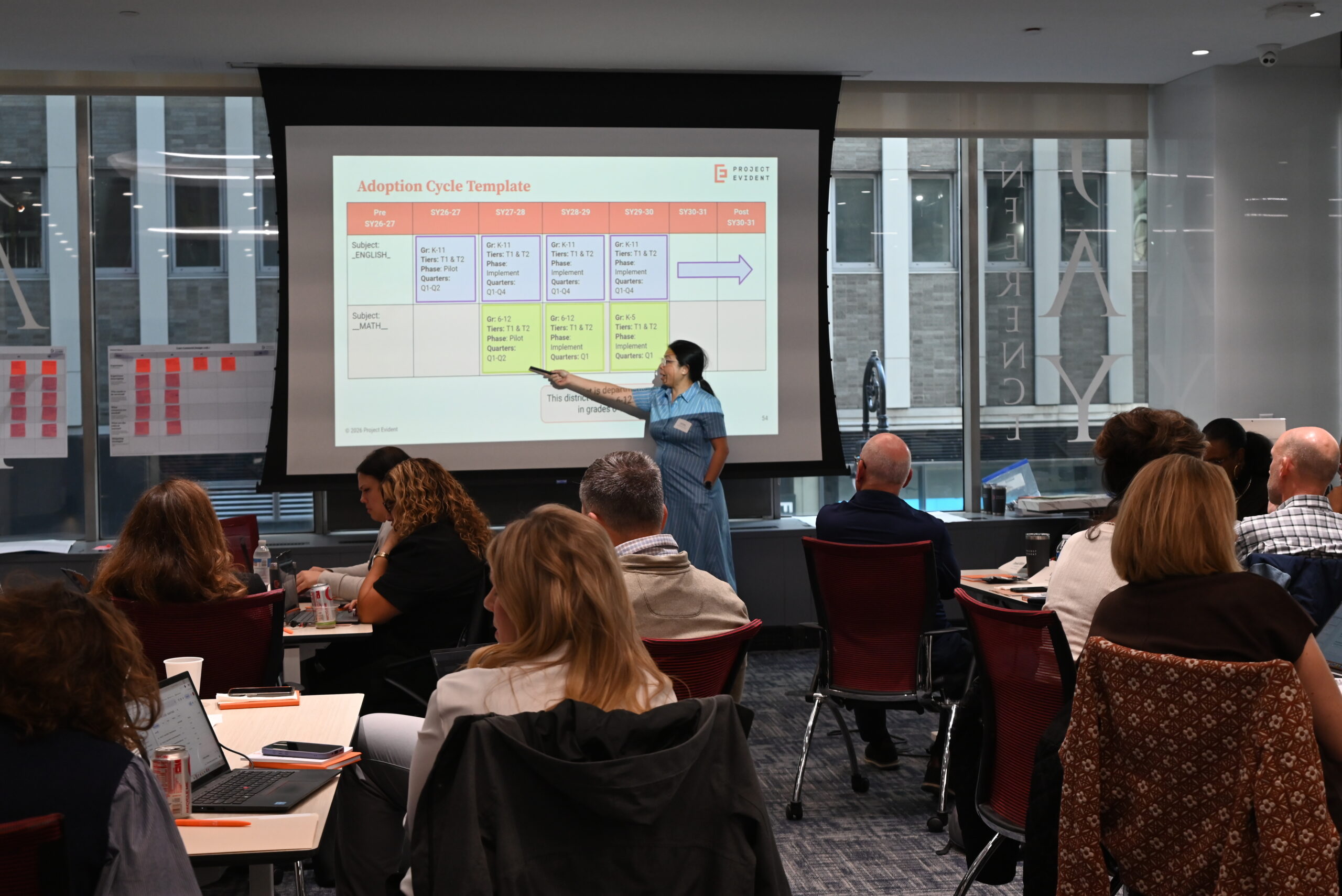
This fall, Project Evident’s Education Agency Practice brought 20+ district leaders from eight school systems to New York City for Reimagining Curriculum Adoption, a two-and-a-half-day convening built around those questions. The districts ranged widely: Austin Public Schools in Minnesota serves about 5,000 students, while Montgomery County Public Schools in Maryland serves more than 150,000 across 200-plus schools.
What they all shared was heavy curriculum demand: new state standards, overlapping adoption cycles, and tighter budgets. Leaders were specific about what they needed. One wanted to “build teacher-centered adoption plans that support staff, maximize engagement, and drive classroom success.” Another pointed to the budget: “Declining enrollment and uncertainty around Title II, III, and IV funds make a disciplined multi-year financial model essential.” Over the course of the convening, teams worked both sides: what teachers need to use a new curriculum well, and what districts can afford to sustain over a full adoption cycle.
Starting with teachers
The work began by focusing on a key factor in curriculum adoption’s success or failure: teachers. Implementation succeeds or fails based on what teachers actually experience. Before discussing timelines or budgets, district teams mapped the academic year from a teacher’s point of view — from spring professional learning that introduces the new materials, to start-of-year training, to quarterly coaching cycles, to the point where teachers confidently adapt lessons on their own.
For each event, teams named who needed to be involved, what resources it required, and what could derail it. The risks they flagged overlapped heavily: teachers who can’t attend professional development, vendor sessions that miss the mark, materials that arrive late, and an instructional vision that never gets clearly communicated.
“Visioning and co-creation with our teacher leaders needs to come before the selection of curricula,” said one participant. Another added, “Clarity of roles, clarity of messaging – there are a lot of action steps that drive toward coherence.”
The exercise also exposed a common gap: few districts had mapped the principal’s role in instructional leadership. Aaron Bouie III, Chief Academic Officer of Youngstown City School District (OH), has seen what closing that gap can do. On a panel moderated by Sagar Gokhale, Managing Director of the Education Agency Practice, he described bringing building principals into planning: “They get a seat at the table – they give us the truth, and they give it unadulterated.” Ultimately, the conversation underscored that expanding access to exploration is important, but more activity alone will not necessarily improve outcomes unless quality, implementation, and learning keep pace.
A fuller view of adoption
Teams used Project Evident’s Multi-Year, Multi-Subject Curriculum Adoption Planner to plot expected curriculum adoptions over the next five years onto a single timeline. The tool’s dashboard then asked four direct questions:
- Do we have enough funding?
- Do we have enough people to support teachers?
- Do teachers have time to turn learning into practice?
- Do principals and coaches have time to coach?
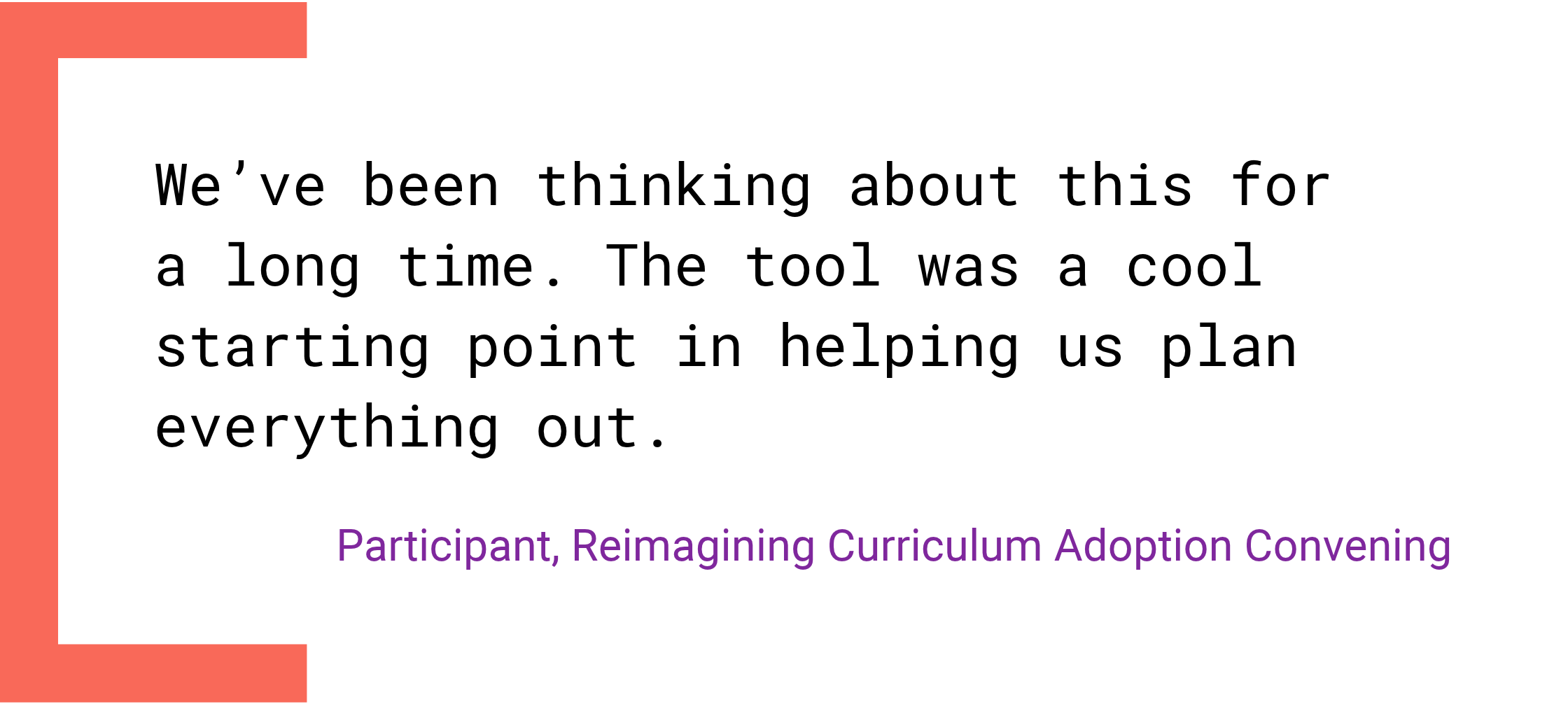
The planning exercise generated strong energy and engagement. One district leader said, “We’ve never planned implementation before; we just implemented.” For districts used to planning one adoption at a time, seeing pilots, rollouts, and refresh cycles stacked on top of each other made capacity conflicts visible in a way a single-subject planning cannot.
Putting a real number on it
Next, teams examined what an adoption costs once implementation is factored in. Using Project Evident’s Curriculum Adoption Financial Model, pre-loaded with each district’s enrollment data, each team practiced on one subject, building out its full cost over multiple years: student and teacher materials, digital licenses, replacement rates, and, critically, the professional learning required to make the materials work.
The model showed how a subject-by-subject view understates the true costs, and how expenses that look manageable in the adoption year can become pressure points in years three and four. It also got academic and finance leaders building the plan together. “This was the first time that as a district instructional leader I was able to co-plan with a multi-year framework alongside my district finance director,” said one participant.
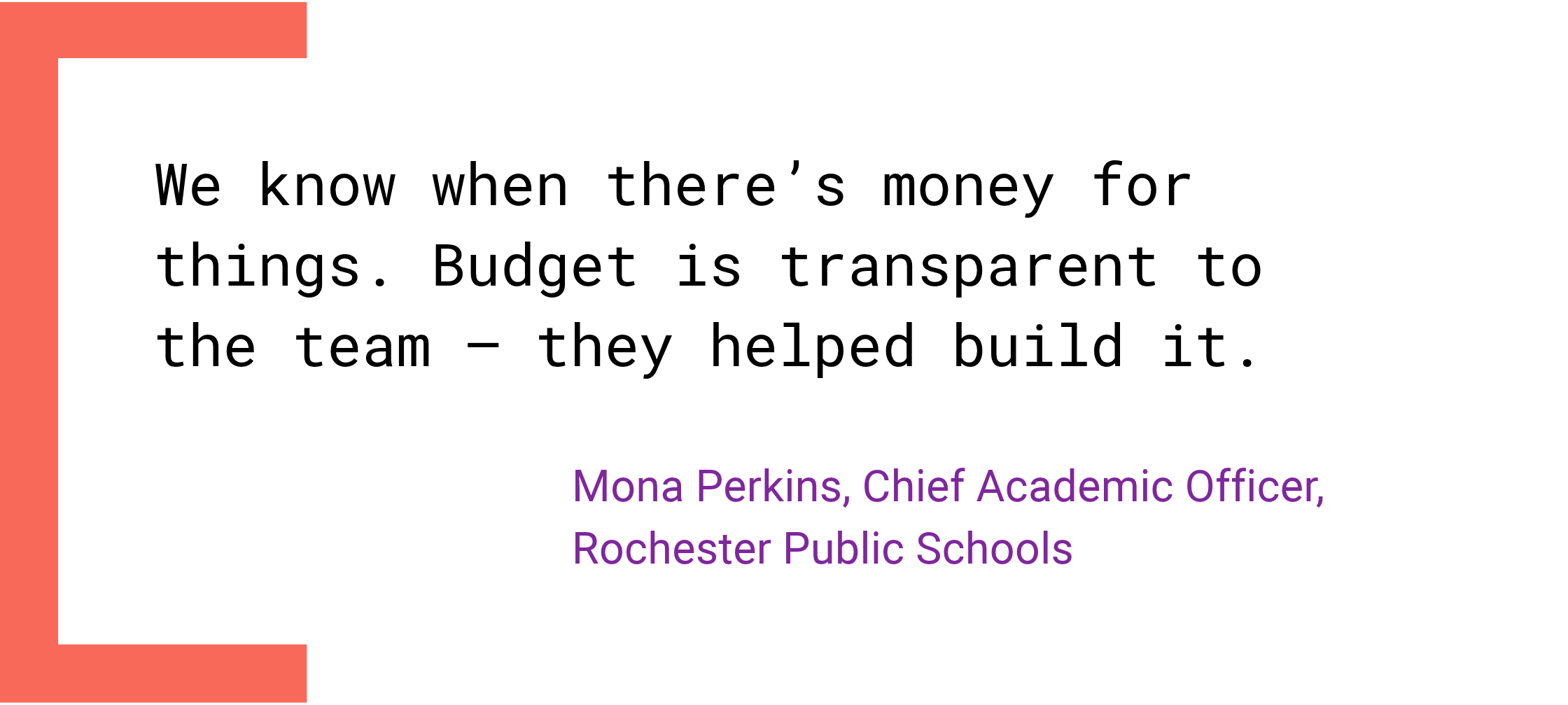
Mona Perkins, Chief Academic Officer of Rochester Public Schools (MN), described the same divide in her own district: “I realized I don’t speak finance, and our finance director didn’t speak academics.” Today her district has a five-year plan. “We now know when there’s money for things. Budget is transparent to the team – they helped build it.”
The hard conversations that lead to action
Every plan and budget process requires trade-offs. Teams identified some of the pain points most pressing for their district and worked through them together:
- Paying for quality across the full adoption cycle, including which existing commitments to delay or end.
- Pacing the rollout to match teachers’ real capacity to learn and apply new materials.
- Sustaining consistent support as needs shift from launch to long-term use.
- Deciding what to stop doing, and actually stopping it.
Next, they translated their decisions into action plans with milestones, interdependencies, and a single owner for each task. Participants noted that this session helped them plan their curriculum adoption process and think critically about what systemic changes were needed. “Having the time to reflect and map timeline and steps for adoption and implementation allowed us to reflect and be strategic on our next steps,” said one.
Knowing early whether it’s working
One district raised a question that sits under every evaluation: how do you know what’s working if teachers aren’t using what you provide? Project Evident’s evaluation framework starts there. It asks whether the district did what it said it would and whether the curriculum reached the intended teachers and students before asking whether it worked and was worth it.
Nitika Tolani and Poorvaja Sundar of the Research Partnership for Professional Learning (RPPL), an organization that leads research on the impact of curriculum-based professional learning, focused on one piece of that picture: how to read the early signals. Teachers’ confidence can run ahead of their practice, so a strong survey may overstate change in the classroom. Practice usually shifts before test scores do, so flat scores in year one may not mean failure. Their advice was to evaluate the professional learning alongside the materials, because high-quality materials rarely change teaching on their own.
What districts are taking home
Each team left with a teacher-experience design, a multi-year adoption timeline, a draft financial model, and an action plan. The next step is to flesh out the full five-year plan, with every upcoming adoption costed, alongside a cross-functional team that brings academic and school leaders together with budget and grants staff. Working together keeps the plan grounded in how the district really operates, and gives the people responsible for implementation a stake in its success.
Curriculum adoption is often treated as a selection decision. The districts in this cohort are treating it as a multi-year commitment, one that has to work for teachers, hold up financially, and produce evidence leaders can act on. The same approach can be applied to any major rollout from career and technical education to high-dosage tutoring.
Said one colleague, “It’s amazing what districts are up against – yet somehow we manage. Educators always make something happen, despite the obstacles.”
To learn more about the Education Agency Practice, please contact Sagar Gokhale.