Making Career Exploration Add Up for Young People: Reflections from Practitioners at JFF Horizons
Young people begin forming ideas about careers and their own potential early in adolescence. They narrow career options they will consider by early teens, often based on perceptions of gender and class and on limited exposure to what actually exists. What they encounter and experience around them in those years shapes their emerging sense of self and what they believe is possible. This makes early, sustained, and high-quality career exploration a developmental necessity for students in middle and high schools.
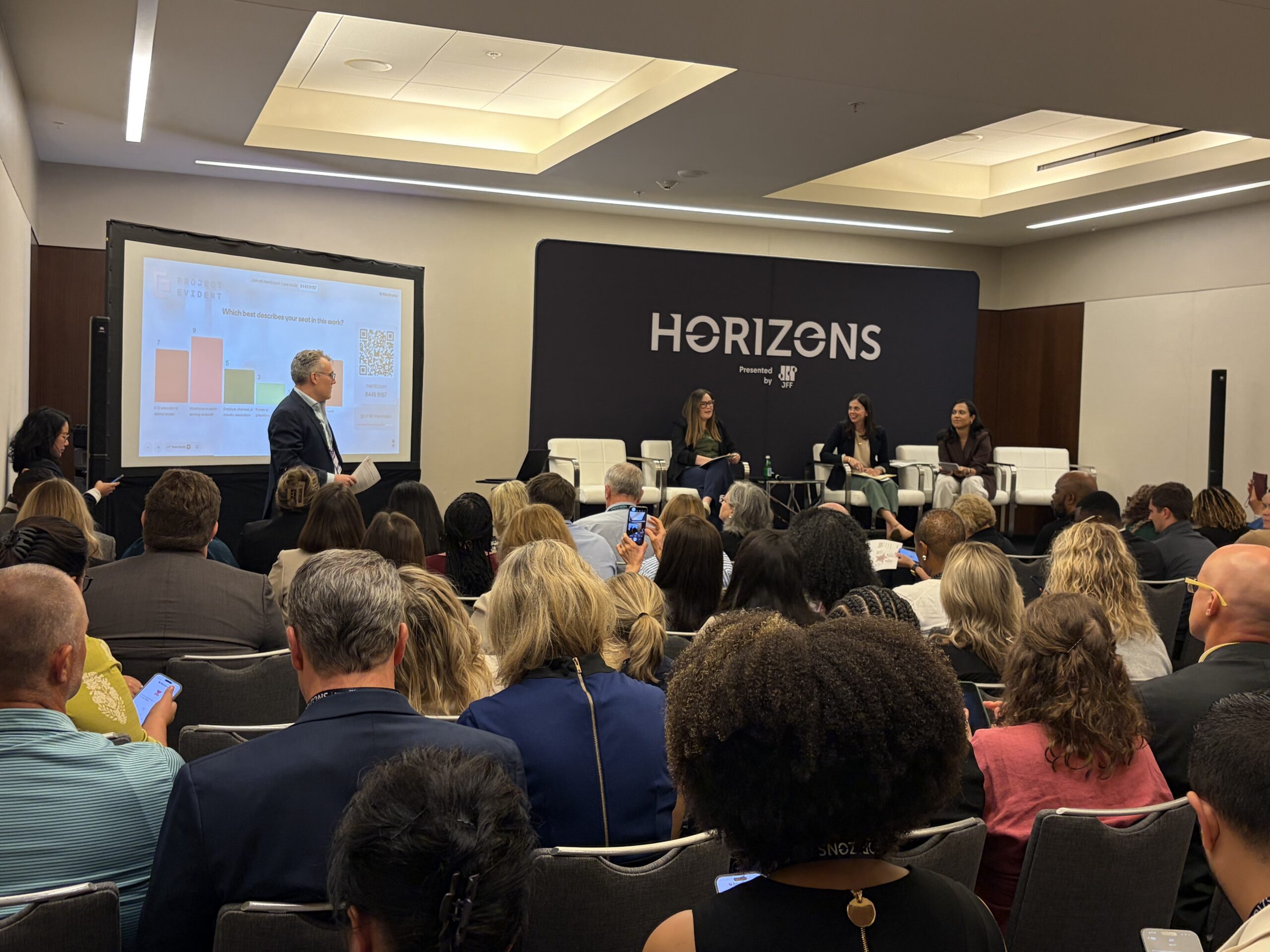
Evidence links certain career exploration experiences in adolescence to stronger employment, earnings, and career satisfaction later in life. As states, schools, and communities expand career exploration programs and opportunities, the question is no longer simply whether it matters but how to deliver effective experiences that produce meaningful outcomes for young people. That question framed our panel at the 2026 Horizons Summit, hosted by Jobs for the Future (JFF), where we presented findings from our recent assessment on the state of K-12 career exploration.
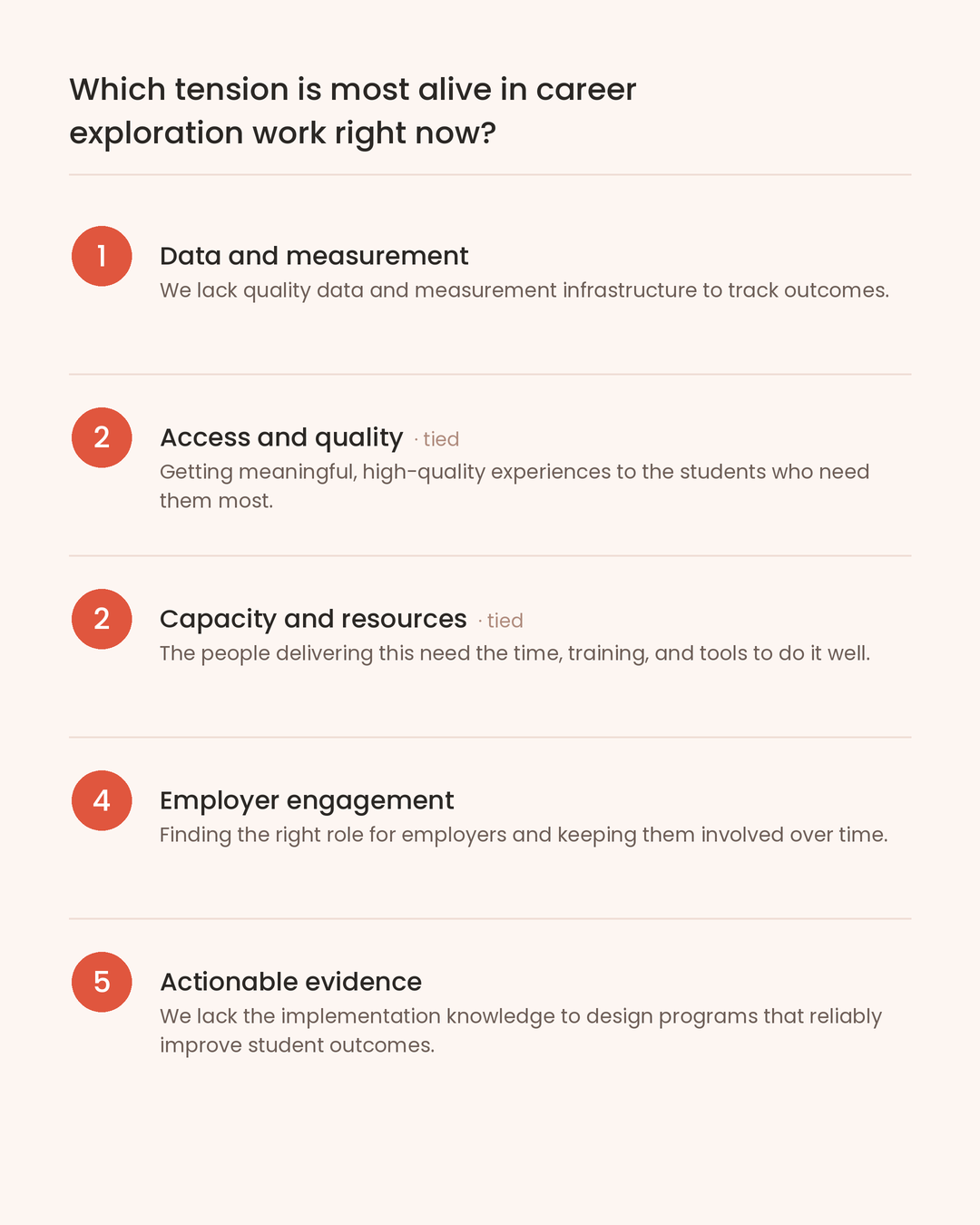
During the panel, we asked more than 80 educators, state and district leaders, youth- and workforce-serving practitioners, funders, and employer and industry representatives in attendance about the most pressing tensions in their career exploration work.
Data and measurement rose to the top, reinforcing a central finding from our assessment: that the field needs greater agreement on what high-quality career exploration should help young people gain, shared approaches to measuring progress, and better evidence about what works, for whom, and under what conditions. Together, these foundations can help us improve, scale, and sustain effective career exploration for every young person.
Horizons Panel
Earlier this year, Project Evident released a series of publications from an in-depth assessment of career exploration practices and evidence. We reviewed research across youth development, career development, education, and workforce and interviewed nearly 50 practitioners, researchers, and state and district leaders. We found that young people want and need repeated, hands-on opportunities to investigate, reflect, connect, and revise their understanding of themselves and their options. Yet their experiences with career exploration vary widely in depth, quality, and coherence, often leaving out what young people say helps them most.
At Horizons, I joined my Project Evident colleague Gabriel Rhoads, Jamie Jutila of the Walton Family Foundation, and Jaimie Francis of the U.S. Chamber of Commerce Foundation to discuss an evidence-informed framework for high-quality career exploration developed through our assessment. The framework describes what young people need from exploration: opportunities for self-discovery, environmental exploration, navigation, and building relationships, networks, and durable skills.
Our panel also considered what it takes to deliver that quality in practice. Jamie Jutila underscored the importance of further defining “what good looks like” as states continue to expand career exploration. From a practice perspective, she pointed to coherent, integrated approaches that build over time and help students make sense of their options, rather than a collection of one-off activities.
Jaimie Francis focused on durable employer engagement: meeting employers where they are, connecting exploration to both corporate social responsibility and talent strategy, and offering a menu of ways for them to participate, from lower-commitment activities like guest speaking to higher-commitment roles like internships and project-based learning. (A practice brief from our assessment provides more insights on challenges and opportunities around employer engagement).
Ultimately, the conversation underscored that expanding access to exploration is important, but more activity alone will not necessarily improve outcomes unless quality, implementation, and learning keep pace.
Audience Insights
Audience members brought their own experience and insights to the discussion. Beyond data and measurement, four threads stood out:
- Center student voice. “Student voice” was the most prominent response when we asked what must be in place for career exploration to drive outcomes. Young people and families should be partners in designing programs, defining quality, and setting target outcomes.
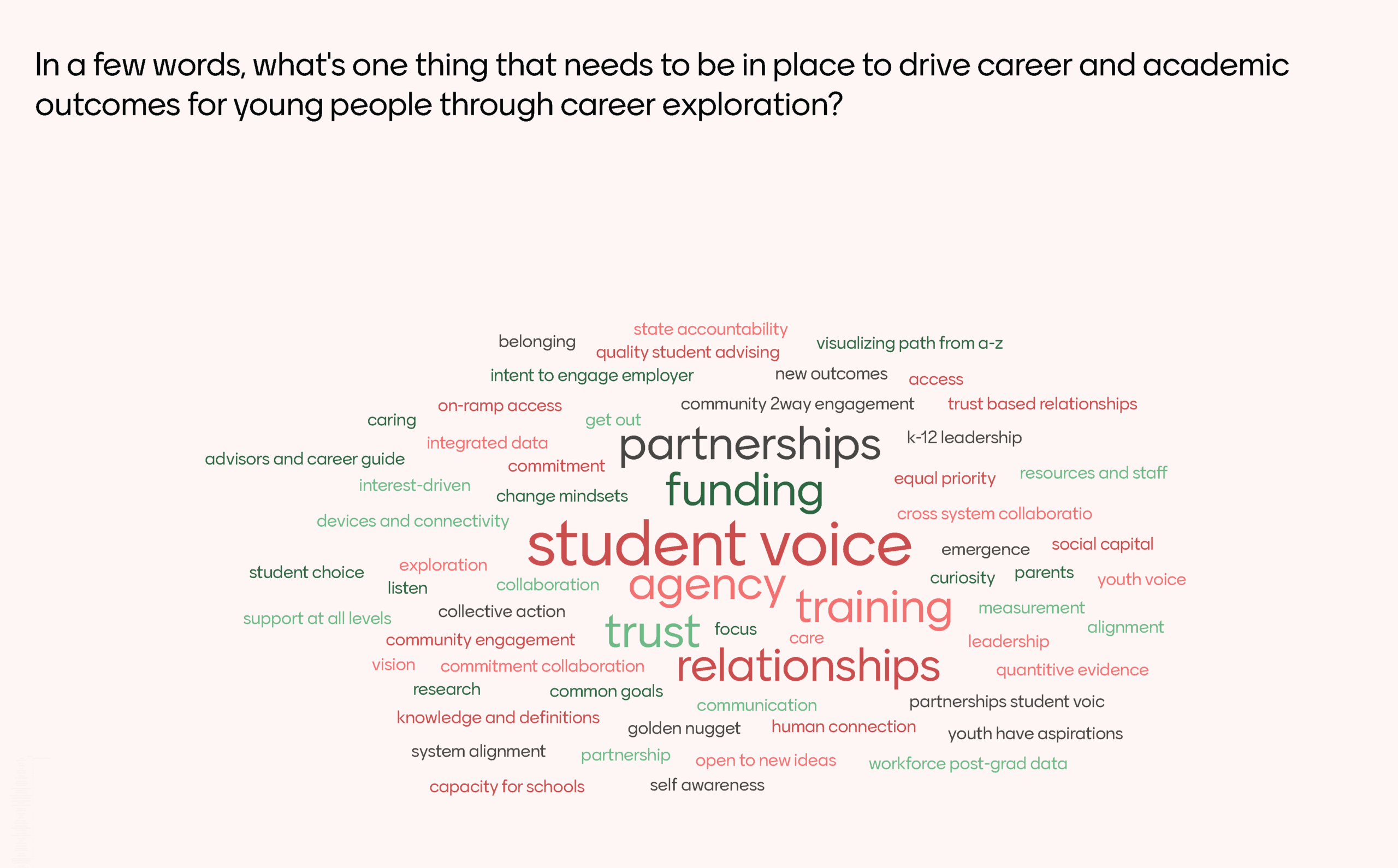
- Equip the adults around young people. Audience members raised parent engagement and teacher professional development as core parts of the work. Families and trusted adults shape how young people understand careers and what opportunities they can access. However, most efforts focus solely on students. Teachers, counselors, and youth practitioners need training, coaching, practical tools, protected time, and clear roles to provide quality experiences.
- Align systems and incentives for sustained quality. Audience members called for stronger connections between K-12 systems and the community-based organizations that run afterschool and summer programs to deliver coherent, connected experiences for young people. They also noted that accountability systems often place greater weight on academic performance and college readiness, even where states name career exploration as a priority. Moving beyond one-off programs and individual champions requires integrating exploration across school-day and out-of-school settings and investing in the data, practitioner capacity, and partnership coordination needed to sustain quality over time.
This work is already happening in pockets across the country. What we heard at the JFF panel lines up strongly with our assessment and recommendations: that the field needs stronger cross-sector coordination and sustained investment that aligns policy, practice, and measurement. We will keep working on that, and we would welcome others who want to build it with us.
You can read the white paper, evidence brief, and practice brief here.
Farhana Hossain is a Senior Advisor to the Evidence for Outcomes practice at Project Evident.