TOOLS AND RESOURCES
Where Does Your Foundation Stand on AI? Introducing the AI Journey Map for Philanthropy
Download PDF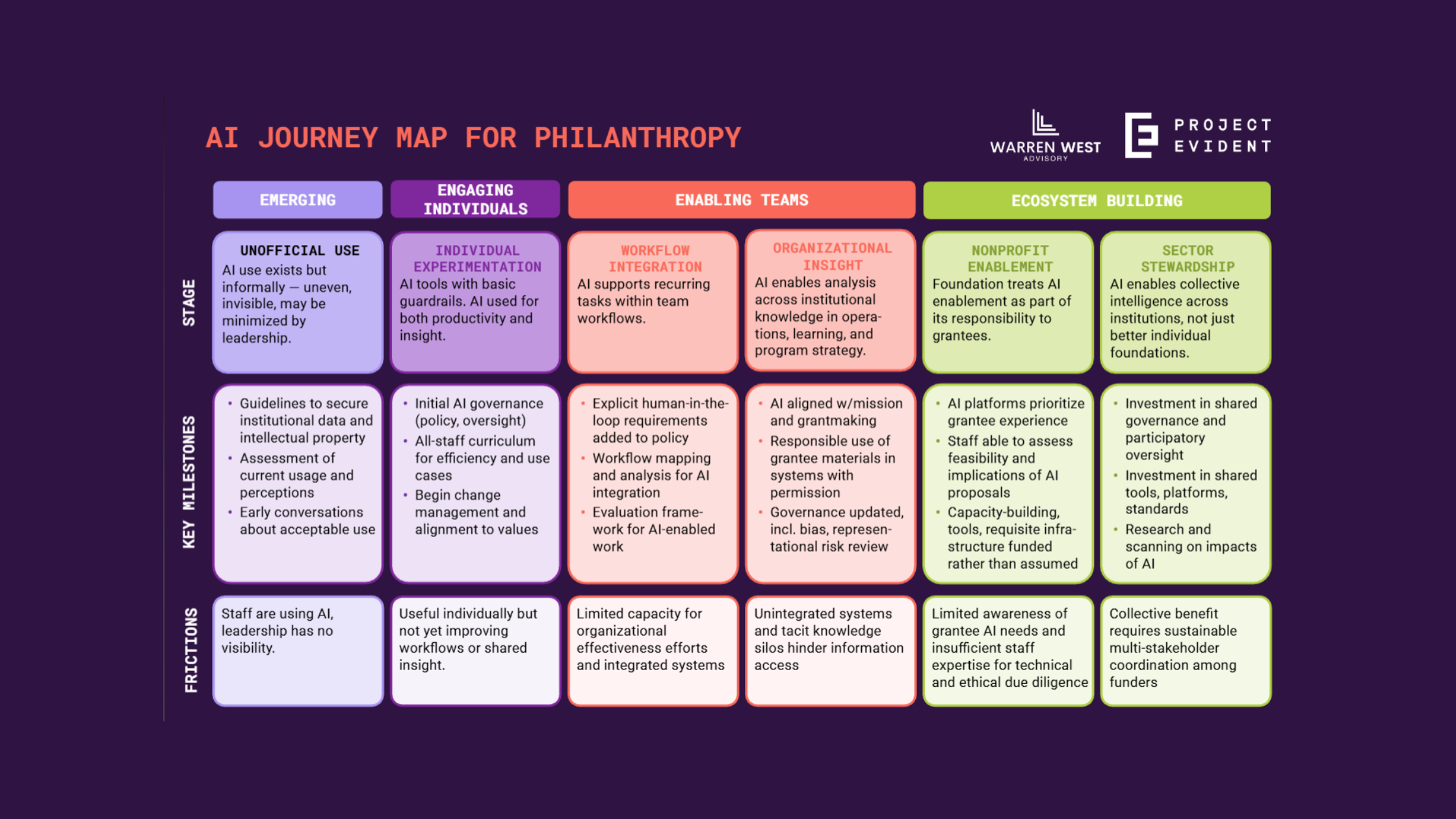
Most foundations haven’t chosen their approach to AI so much as inherited it. They’re fielding questions from every direction — from grantees exploring new tools to boards asking about strategy. This doesn’t reflect a lack of vision; it’s a natural response to a moment moving faster than any one institution can track. But operating in reactive mode has a cost. Waiting for philanthropy to lead can mean waiting a long time.
At this point, foundation leaders rarely need convincing that AI matters. What they lack is a clear picture of what their staff knows, what their grantees need, and where capacity falls short of opportunity. You can’t close a gap you haven’t mapped. The AI Journey Map for Philanthropy is designed to help foundations move from an inherited position to an intentional one, with a clear picture of where they stand and a path forward that reflects their values and capacity as well as their obligation to field-level stewardship.
The Map at a Glance
In 2023, we developed the Responsible AI Adoption Framework for Philanthropy in collaboration with the Technology Association of Grantmakers. Since then, AI has evolved dramatically — and so has our collective knowledge, built across hundreds of engagements with grantmakers, foundations, and nonprofits. This map is what we’ve learned alongside everyday practitioners — like the Midwestern foundation that moved, in just 6 months, from significant “shadow AI” usage to shared governance, licensed tools, inclusive training, and a plan for insight-enablement with AI.
The AI Journey Map for Philanthropy spans the full arc of a foundation’s AI transformation — from the earliest stages of unofficial, ungoverned use to the collective intelligence that reshapes a field’s potential.
The goal isn’t to reach a final state of maturity. Some foundations will move through all six stages; others will stop where their mission is best served. Some foundations start with nonprofit enablement before setting their own internal course. The key is knowing where you are today and choosing deliberately where to go.
Understanding the Stages
Each stage of the Map describes a recognizable place where foundations might find themselves, as well as the friction points between stages where foundations most often stall. Here’s what each one looks like in practice.
Unofficial Use
This is where most foundations begin. Whether intentionally or not, AI is already inside the organization, largely invisible and often unsanctioned. The first milestone isn’t to stop it; it’s to see it and create safe practice and guidelines. At one East Coast foundation Coco worked with, a staff survey revealed that more than 60% of employees regularly used personal AI accounts for work — something no one on the leadership team had anticipated. Anonymous usage surveys, early guidelines for acceptable use and data privacy, as well as an honest assessment of current perceptions are how a foundation moves from invisible use to intentional practice.
Individual Experimentation
At this stage, AI tools are licensed, with individuals using them for basic tasks such as drafting or editing emails and reports, or reviewing contracts. However, the benefit is individual, not organizational. It hasn’t crossed into shared workflows or collective insight, and the infrastructure — standardized processes, shared agents, accessible shared knowledge, or safe innovation environments for low-code applications (vibe-coding) — for using AI as a team isn’t in place. This is required for efficiency at the team or organizational level, and most foundations aren’t there yet.
Workflow Integration
Foundations moving from individual to team-wide or org-wide usage primarily use AI to improve efficiency. Core workflows are documented, with AI support identified and deployed, including helpdesk chatbots and grant and investment due diligence agents. Here, the organization invests more deeply in the people side of AI, including sustained change management and ongoing skill-building. AI begins to reshape team workflows, not just outputs, and leadership gains an appreciation for AI’s operational role. However, there’s a meaningful difference between using AI to do things faster and using AI to unearth insight — to find patterns across a portfolio, pressure-test assumptions, or check biases. Both are meaningful uses of AI in grantmaking work.
Organizational Insight
Typically, after six to nine months of intentional effort, most foundations set their sights on using AI for organizational-level insights. Here, AI surfaces patterns in institutional data such as portfolio-level analysis and synthesis, scenario planning, or even bias detection in decision-making. Insights become accessible and contestable, decision-making improves, but responsibility remains human. AI begins to shape knowledge management and realize the dream of “enterprise search” across knowledge siloes. This stage isn’t easy, however, as unintegrated systems and data gatekeeping across departments limit the utility of AI until addressed.
Nonprofit Enablement
While some organizations (just 10% according to a recent study by the Center for Effective Philanthropy) have already started funding AI enablement for their nonprofit partners, this stage is the leap that most foundations have failed to make; in part because foundations assume they have to be using AI well internally to enable grantees to do the same. Foundations can enter this stage at any time by assessing grantee interest in AI, building program officer capacity to evaluate AI proposals on both technical and ethical grounds, and funding AI capacity for grantees rather than assuming it. In practice, this stage doesn’t have to wait for full internal readiness. Foundations can, and should, be enabling grantees in parallel, not sequentially.
Sector Stewardship
This stage is where the field-level impact of philanthropy’s leadership posture on AI ultimately lives — in shared data standards and AI connectors, cross-funder coordination, and collective intelligence across institutions. While some AI funder collaborations are emerging, such as NextLadder Ventures and Humanity AI, most foundations have yet to see this as their responsibility, let alone to invest in shared AI infrastructure for the field. But for those willing to lead, this stage is where foundations stop optimizing only for their work and start shaping the possibilities for everyone else’s.
From Diagnosis to Action
Knowing where you are is the precondition, but it’s not sufficient on its own. Moving across stages isn’t primarily a technology challenge; it’s an institutional one. The decisions required at each stage touch governance, culture, data policy, grantee enablement strategy, and cross-funder coordination — and they belong with CEOs, program directors, and board leadership, not delegated to any single function.
The AI Journey Map is being released as a public resource because the field needs north stars — a shared vocabulary, an honest picture of where foundations commonly get stuck, and a concrete sense of what each next stage requires. If you’re navigating this internally, it’s designed to be the foundation for that conversation.
Philanthropy has an opportunity here that it won’t have indefinitely. Foundations that move intentionally on AI are the ones that will help shape what AI becomes. The AI Journey Map is an invitation to begin that transformation: with best practices, lessons learned, and a commitment to enablement that extends beyond your own four walls.
Ready for the next step in your AI Journey?
For foundations seeking structured support, we are convening a six-month cohort that brings cross-functional leadership teams through shared learning, coaching, and a capstone project to pilot AI for mission-related insights.

Coco Forster · Warren West Advisory
View profile