INSIGHTS
Making Evidence-Based Practices Work in Curriculum Adoption: Lessons from the Education Agency Practice Spring Convening
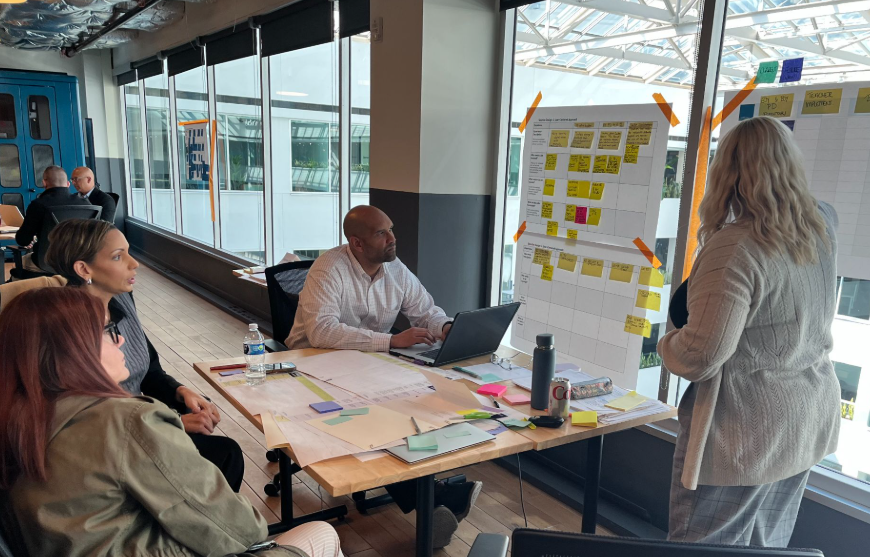
In education, the hardest part isn’t deciding what to do; it’s building the conditions that make it actually work. That’s what brought Project Evident and four school districts together in Philadelphia in April at the Education Agency Practice Spring Convening. Project Evident’s Education Agency Practice helps state and local education leaders put data and evidence to work in the operational, financial, and programmatic decisions that shape what happens in classrooms. This spring, teams from Cecil County, MD; Youngstown, OH; Delaware City, OH; and Rochester, MN gathered to dedicate a few days to the future of resource allocation in education.
This convening is part of a broader partnership with the Gates Foundation to develop and test practical tools for successful curriculum adoption that districts can take back and put to immediate use. These include a curriculum adoption timeline and a corresponding set of implementation plans that detail: strategic resource allocation, a multi-year funding approach, and professional development pathways to support all educators through the curriculum adoption process. But tools alone don’t change practice. The districts came in knowing that the harder work happens with people.
“We are asking [teachers] to go against the way they were taught as kids, the way they were taught in college, the way their own kids were taught,” said Roshay Huff, an Instructional Math Content Specialist at Youngstown City School District. “When I ask them to put in a new curriculum, I’m really asking people to change their whole brain in how they teach.”
It’s a challenge that goes to the heart of implementation. During the convening, district leaders dove deep into the details of implementation planning, including:
User-Centered Design of Professional Development Plans:
Districts built their professional development plans from the ground up – starting not with content, but with teachers’ experiences. The question driving this work was: what do we want teachers to feel and know as they move through the curriculum adoption process?
“The user-centered design approach was a fresh take on looking at this problem in a new way,” said Shawn Johnson, Executive Director of Elementary School Education at Cecil County Public Schools. “I’m interested to see how we can apply it to other projects in our district.”
The user-centered design approach isn’t unique to curriculum adoption. The same framework applies across the range of challenges districts face, from career-connected learning to post-secondary pathways — anywhere that implementation depends on the people closest to students.
Staffing Alignment:
Successful implementation doesn’t happen without the right people in the right roles. Districts curated a comprehensive mapping and restructuring of staff responsibilities for curriculum implementation, helping them pinpoint critical gaps and ensuring the right teams were in place and prepared before the hard work of curriculum implementation begins.
“We’ve got 500 things we’ve got to battle every single day,” said Aaron Bouie III, Chief Academic Officer, Youngstown City School District. “We have to figure out what team to throw at it, what playbook are we going to use to tackle all of those things.”
Measuring Progress:
Knowing what to do when it comes to curriculum implementation is one thing; knowing whether it’s working is another. Districts reviewed evaluation methodologies and designed their own approaches to measuring student outcomes, building the evidence infrastructure that will allow them to track progress as implementation unfolds and adjust course as necessary, ensuring that curricular resources ultimately improve student engagement, learning, and outcomes.
Sagar Gokhale, Managing Director of Project Evident’s Education Agency Practice, reflected on what made the convening meaningful: “Districts commit millions of dollars every year to their curricular materials, and we know that high-quality instructional materials can have a real impact on student engagement, learning, and outcomes. But that impact doesn’t happen without commitment, planning, and focus. What was encouraging about this convening was seeing four districts genuinely center their teachers — the people most able to bring curriculum to life — and build their entire implementation approach around what would set those teachers up for success.”
We are excited to continue our work with these district leaders as they plan for the next school year and beyond.
For district and state education leaders looking to strengthen their use of evidence in decision-making and implement sustainable system-wide initiatives (such as curriculum implementation or career-connected learning), please contact Sagar Gokhale at sgokhale@projectevident.org.